
Changing the Narrative: Suicide in detention
CONTENT NOTE: This article discusses themes of suicide, self-harm and self-inflicted deaths.
This World Suicide Prevention Day, which took place on 10 September, was the third and final year of the theme Changing the Narrative on Suicide. At the individual level, this theme aims to challenge myths, reduce stigma and foster compassionate conversations about suicide. However, changing the narrative must also happen at a systemic and structural level, especially in places of deprivation of liberty.
Suicide prevention must go beyond individual, clinical vulnerability, and be thought of in terms of what establishments, public services and State authorities are doing to keep people safe. We must ask whether the system has created conditions in which help can be sought by individuals and whether staff are properly supported to provide it.
“Changing the narrative also means driving systemic change. It calls for suicide prevention and mental health to be a priority in public policy, urging governments and institutions to take action. This includes developing and implementing evidence-based strategies, improving access to quality care, and ensuring that those in distress receive the support they need.” – WHO
It is acutely important to “change the narrative” in places where the State has deprived someone of their liberty, and where there is then a legal and moral duty of care to protect human life as mandated by ECHR Article 2. Deaths in detention reflect directly on the safety and decency of State-run systems.
Suicide prevention as an institutional responsibility
Being deprived of one’s liberty affects both the risk factors for suicide, and where the responsibility for prevention sits. People deprived of their liberty are almost entirely dependent on State institutions for their safety, yet remain largely absent from mainstream conversations on suicide. This blog aims to share why it is so important to remember those deprived of their liberty in conversations about suicide prevention, and what a genuine change in the narrative should mean for the system responsible for keeping them safe.
While isolated incidents of suicide require thorough consideration and reflection for learning, these should be analysed collectively and as part of a wider picture to ensure the system and the environment adapt to prevent such incidents in the future.
Why deprivation of liberty settings require particular attention
Samaritans’ research on prisons found that people in custody face a heightened risk of suicide because of a distinctive combination of pre-existing vulnerabilities and features of prison life.[1] Pre-existing vulnerabilities – including poor mental health, deprivation and trauma – are disproportionately common among those who are subsequently imprisoned. Once in prison, those vulnerabilities can be compounded by the conditions of the establishment itself, including social and physical isolation, uncertainty over sentences, exposure to self-harm and self-inflicted deaths, and the difficulty of adjusting to prison life. This is demonstrated by the evidence, which showed that a significant proportion of self-inflicted deaths in reception prisons in England and Wales occurred within the first month of custody.[2]
While the above is drawn from prisons, where there is the richest evidence base, the underlying vulnerabilities recur across other settings too. Isolation, uncertainty and unmet needs are also present in immigration detention and secure mental health wards. While police custody, court custody and secure children’s accommodation see much fewer deaths within the custody period overall, it is important to note the implicit vulnerabilities that may affect those leaving such settings and to ensure that safety planning and support do not simply stop at the point of release.
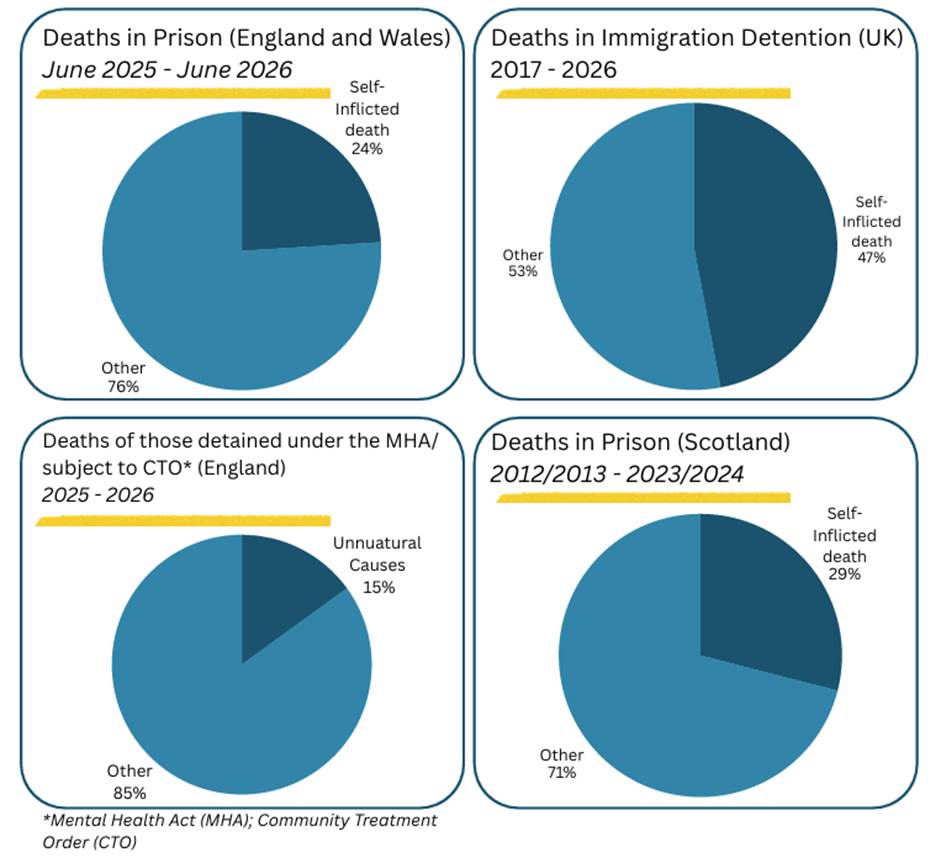
There is no single, comparable dataset on suicides across all deprivation of liberty settings and UK jurisdictions, making it harder to see patterns of risk across the whole system.Below is a visualisation of some of the data regarding self-inflicted deaths in deprivation of liberty settings. It is important to note that not every self-inflicted death is recorded as a suicide. The figures are not directly comparable as classifications vary between jurisdictions and settings, and are only intended to give a snapshot of the issue based on the most recent, readily accessible data.
An overview of self-inflicted deaths in deprivation of liberty settings[3]
Different settings, recurring systemic risks
Despite the lack of comparable data, the UK NPM’s Reporting Dashboard offers another way to understand recurring themes within recommendations relating to self-inflicted deaths in places of deprivation of liberty. Perhaps unsurprisingly, most related recommendations come from prison inspection and monitoring reports. However, some were also found in reports on immigration detention. It is important to note that this reflects the number of prisons across the UK, and the frequency with which they are inspected and monitored, but it does not mean that other deprivation of liberty settings are free from these risks, or that the themes below cannot be applied to those settings.
Several of the recommendations point to the same underlying problem: that a gap exists between the policy and practice of suicide prevention. The frameworks for identifying and managing risk already exist – for example, Scotland’s prisons’ Talk to Me (TTM) policy, the Assessment, Care in Custody and Teamwork (ACCT) case management in prisons across England and Wales, and the use of Rule 35 in immigration detention, to name a few – but inspection findings continue to highlight gaps between the framework on paper and what happens in reality.
For example, the Committee for the Prevention of Torture (CPT) recommended in its most recent report, on an ad hoc visit to Scotland in June 2025, that Scottish authorities ensure that the TTM policy “does not become merely a box-ticking exercise”.[4] At some establishments, both the IMB and HMIP had noted that ACCT processes could be strengthened, and that staff were not always following correct procedures. The frameworks themselves are often not the problem. The challenge lies in how consistently they are implemented, quality assured and overseen.
To mitigate suicide prevention work becoming a paperwork exercise, the CPT recommended to Scottish authorities that anyone presenting a risk of suicide should receive assessment, treatment, counselling and support, as well as ongoing monitoring. Alongside this, the CPT recommended increased meaningful staff contact for those on TTM, and appropriate association with other prisoners. This approach should be the norm in any setting across the country. However, HMIP has found that support for some prisoners in crisis to be poor, and IMBs have repeatedly raised concerns regarding delays in health assessments and Rule 35 reports in immigration detention.
The consistency of staff training and support also appears as an area of concern. The CPT called for mandatory, structured training covering suicide prevention, self-harm management, mental health crises, trauma-informed care and de-escalation, but IMBs, at some establishments, have questioned whether the current staffing levels – a pressure felt across all settings and jurisdictions – leave any real room for such training to happen.
What good practice looks like
Evidence shows that early days in custody are often the riskiest for those in crisis. The NPM reporting dashboard contains several examples of good practice where establishments have introduced practical measures to improve the care and support available:
- Early days in custody: The Early Days in Custody pilot project, delivered at HMP Durham and HMP Low Newton between April 2020 and June 2023, gave prisoners and their families a dedicated point of contact during their first two weeks in custody. This helped them stay in touch through visits, and adjust to their environment. An evaluation found that the project had also played an important safeguarding role by connecting prisoners with safer custody teams and outside agencies.
- Accountability and assurance: At one prison, suicide and self-harm training had been delivered prison-wide, and the safety team had introduced CCTV-based quality assurance reviews to check that ACCT observations were being carried out as recorded.
- Dedicated care coordination: In another prison, a dedicated group of care coordinators had been trained to manage all ACCT reviews. Coordinators could give individual prisoners more time and connect them to wider sources of support – work, education, faith staff and Listeners – because this was their core role. These coordinators were praised for bringing “human decency” to the reviews.
- Multidisciplinary support: A prison embedded trained counsellors within their safer custody team as ACCT case managers, enabling multidisciplinary care planning, alongside working directly with the individual.
These examples show that effective suicide prevention is not only about having the right procedures in place. It also depends on meaningful contact, skilled staff, appropriate oversight and practical support. While these examples should be recognised and praised, they should not remain exceptional. Approaches like these should be embedded into the day-to-day working of every establishment, across all deprivation of liberty settings.
Learning to Sustain Change
Changing the narrative on suicide in detention means recognising that prevention depends not only on individual care, but on the conditions, relationships and systems created by institutions. The findings outlined above offer foundations on which to build. The challenge for authorities and establishments is to ensure that good practice is not exceptional, but embedded, resourced and sustained.
For support with any of the topics discussed above, you can contact Samaritans on 116 123 or visit their website for more information.
[1] Unlocking the Evidence: Understanding Suicide in Prisons, Samaritans (2019)
[2] Self-inflicted death in reception prisons, Prison and Probation Ombudsman (2026): In 11% of cases, self-inflicted deaths occurred within the first 48 hours of entering the reception prison and 30% in the next three weeks, highlighting the vulnerability of prisoners in the early days.
[3] See: Safety in Custody Statistics, England and Wales, GOV.UK (2026); Deaths of immigration detainees, INQUEST (2026); Our regulatory activity in 2024/25, CQC (2026); Deaths in Prison Custody 2012-13 to 2023-24, GOV.SCOT (2026)