NPM Bulletin – April 2026

Welcome
Welcome to the UK NPM’s April bulletin.
Over the past month, the team has continued preparations for the NPM Annual Conference, taking place in Manchester from 29 to 30 April. We have an engaging agenda lined up, which will allow us to explore issues of mental health across different deprivation of liberty settings and hear insights from colleagues working across all the monitoring and inspection bodies in the NPM.
Along with preparation for the conference, the team is finalising our new Business Plan and Communications Plan for 2026/27. These plans will build on the work started throughout 2025/26, and ensure that the UK NPM continues to fulfil its visiting, advisory, cooperation and educational functions.
In other news, Sarah and Jane are finalising a report on findings from the self-evaluation and peer review, which we hope will be an interesting and useful resource for NPM bodies. We would like to once again thank all those who contributed to this process.
We encourage you to share this bulletin with your staff, volunteers and any other interested colleagues, so they can stay up to date with the latest NPM news. If you have received this bulletin as a forwarded email and would like to subscribe, you can subscribe here.
With best wishes,
Martin, Jane, Chelsea and Sarah
The UK NPM Secretariat Team
National Subgroups
The Scotland Subgroup met on 12 March in Glasgow and were pleased to welcome Chris Johnston, a Prison Monitoring Coordinator at HMIPS, who presented recent IPM findings on mental health transfer times. His insights helped frame a fruitful conversation on mental health transfers, as well as personality disorder in prisons, and the group discussed current challenges and shared experiences from different monitoring contexts and to consider how these issues are being managed across establishments.
The Northern Ireland Subgroup are very pleased to welcome Tom Lord, NIHRC, to the subgroup. Tom has previously worked at the Irish Penal Reform Trust and the New Zealand Ombudsman, and brings invaluable expertise and experience to the group. The Northern Ireland subgroup will also be hosting an event on personality disorder in prisons in June, which will feature interventions from justice and clinical experts, followed by a roundtable session to share best practice and challenges in provision for people with personality disorder.
Blog: Autism Awareness Day 2026
Our new blog highlights concerns raised by NPM scrutiny bodies across the UK in the recent years regarding detainees with autism, including inconsistent identification of neurodivergent needs, limited reasonable adjustments, gaps in supported decision-making and the ongoing institutionalisation of autistic people, which could amount to breaches of the Convention on the Rights of Persons with Disabilities.
Using the Reporting Dashboard
Did you know you can use the Reporting Dashboard to do comparative analysis?
The Chart Builder page allows users to create bespoke charts by selecting the data variable you want to see in the chart and the type of chart you want. This can also be a great tool for comparative analysis.
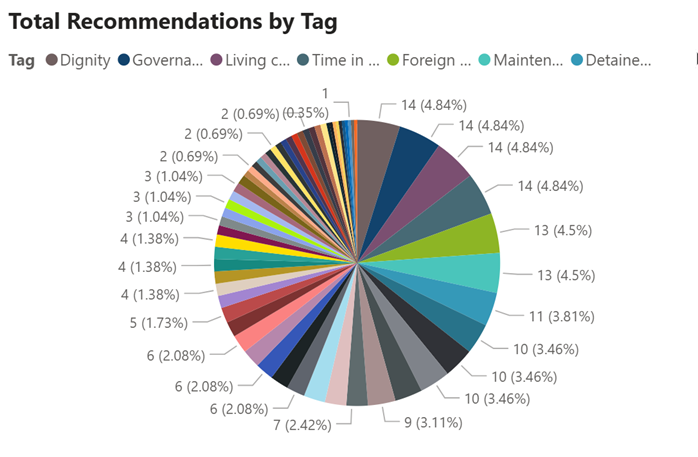
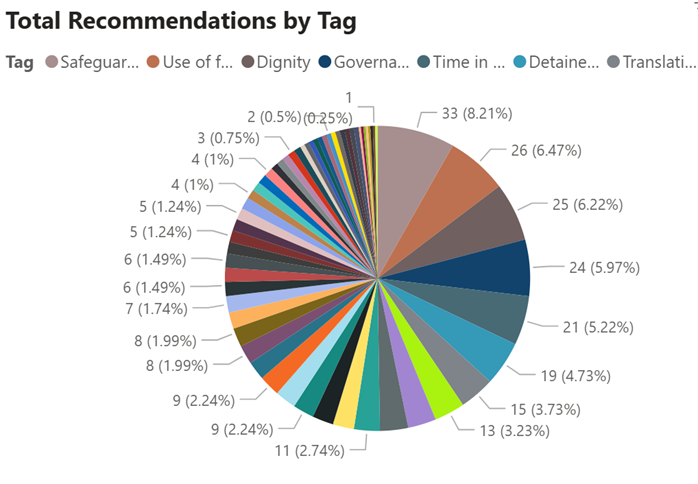
To compare key themes in recommendations in immigration detention in 2022 versus 2025, for example, first select a pie chart to visualise how themes are distributed. The left-hand column will be the data variable (“tags”), and you can filter by setting and recommendation type in the right-hand column. Then, use the data range filter in the top right-hand corner.
Selecting 2022 shows us that key themes were dignity, governance and living conditions, while in 2025 they were safeguarding, use of force and dignity. This shows a shift in the focus of recommendations, but also highlights some continuity in other areas of concern.
For anyone who would like to learn more, you can watch this instructional video, which walks you through some examples of how to use the Reporting Dashboard.
Please let us know how you are using the Dashboard by sending us an email.
Good Practice: Neurodivergence
Findings from UK NPM bodies throughout 2025 and early 2026 show a growing recognition of neurodivergence and an increasing number of establishments introducing more nuanced, person‑centred practices. The examples in this month’s good practice paper reflect a system that is slowly becoming increasingly attuned to the rights and needs of neurodivergent individuals.
Spotlight reports from NPM bodies
Criminal Justice Inspection Northern Ireland – Report on unannounced inspection of Magilligan Prison
Magilligan Prison has been praised in its most recent inspection for its strong rehabilitative culture, excellent staff‑prisoner relationships, and improved outcomes across all four healthy prison tests. Inspectors noted low levels of violence and high time out‑of‑cell, strong education and healthcare developments, and 19 examples of notable positive practice. Key concerns remain around drug misuse, limited substance misuse services, aging infrastructure, and access to offending behaviour programmes.
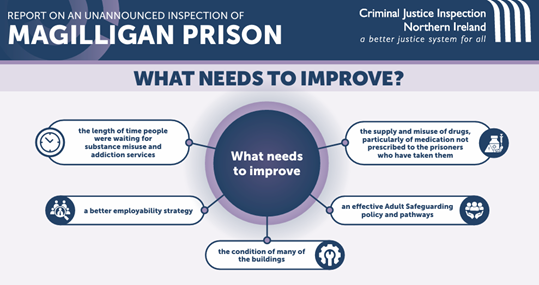
Read here: Report on unannounced inspection of Magilligan Prison
HM Inspectorate of Prisons in Scotland – Report on visit to HMP and YOI Polmont following the FAI Determination in relation to the deaths of William Lindsay and Katie Allan
A recent inspection of HMP & YOI Polmont, commissioned following the Fatal Accident Inquiry into the deaths of Katie Allan and William Lindsay (Brown), found progress on many of the inquiry’s recommendations and strong commitment from staff. However, ongoing strains on mental health services and limited purposeful activity for young men undermined the consistency of care and support available. Further, staffing shortages and restricted activity options continued to affect safety, wellbeing, and development. The report calls for urgent action to expand healthcare capacity, improve daily structure, and create more therapeutic environments for vulnerable young people.
Read here: Report on visit to HMP and YOI Polmont
Latest news from NPM bodies
- CJI staff recently attended a knowledge exchange with the Prisoner Ombudsman to discuss working methods and plans for knowledge sharing in the future.
- CJI also published an inspection report on Magilligan Prison (see above).
- CQC has published research on good practice for dementia care, which highlights that the number of people with dementia is expected to grow in the coming decades, meaning health and social care services will face more pressure. Providing good quality care for those living with dementia is therefore very important. The research discusses good practice in many areas, including care plans and social interaction.
- CQC has also published the results of their annual mental health survey (2025), which shows that people aged 16-35, disabled people and autistic people had worse experiences than average in being treated with care and compassion, getting the help they needed, feeling listened to, getting enough time to discuss their needs, and their overall experience.
- HIW the independent regulator and inspectorate of healthcare in Wales has launched its Strategy for 2026–2030 – a bold plan to put people first, drive improvement across services, and take action where patient safety is most at risk. Shaped by the voices of 2,353 patients, carers, healthcare professionals and members of the public, the strategy focuses on what matters most to people: safe, effective care, timely access, clear communication and services designed around real experiences.
- HMIP has published several inspection reports, and has issued an Urgent Notification for HMP Woodhill, after finding that men were languishing in their cells, criminal behaviour was going unchecked by often inexperienced officers, the dealing and use of drugs was rife and there were frightening levels of violence.
- HMIP has also published two thematic reports. One focuses on the untapped potential of family contact in prisons, which reveals that too many prisons are failing to get the basics right when it comes to family contact. The other focuses on the experiences of remand prisoners, and finds that those awaiting trial or sentencing have poorer outcomes than those serving a sentence.
- HMIPS, as well as the report on the visit to HMP&YOI Polmont noted above, has published a report on an Inspection of Court Custy Provision in Perth, finding professional, motivated and committed staff working in inadequate physical conditions.
- IMB has published several annual monitoring reports.
- MWCS has published inspection reports on two inpatient services for young people: Skye House and Dudhope Young People’s Inpatient Unit. Both reports noted staffing levels and staff training as areas of concern.
- Colleagues at the NIHRC, SHRC and EHRC have issued a joint statement reaffirming the importance of the European Convention of Human Rights and the Human Rights Act 1998 in protecting fundamental rights.
- Ofsted has published inspection reports on Barton Moss Secure Care Centre, Kyloe House, Clayfields House Secure Unit, Aycliffe Secure Centre, Clare Lodge, Atkinson Unit and Adel Beck.
- Colleagues from RQIA and CJI arranged and accompanied Dr Sharon Shalev on visits to Musgrave Police Custody Suite, Woodlands Juvenile Justice Centre and Psychiatric Intensive Care Unit Downshire Hospital and Bluestone Unit as part of the NPM’s research project on solitary confinement.
- SHRC colleagues recently chaired a Criminal Justice Committee roundtable on the human rights implications of Orders of Lifelong Restriction.
If we missed anything, or if you have a report, blog post or news story you would like to share in the next bulletin, please send us an email.
Upcoming events and activities
29 – 30 April 2026: UK NPM Annual Conference 2026, Manchester
11-15 May 2026: Mental Health Awareness Week
15 May 2026: International Day of Families
External resources of interest
The Scottish Criminal Justice Committee published their Legacy Report, as the parliamentary session closes ahead of Scottish elections in May. The report suggests many important issues for consideration in the upcoming session, including policing and mental health, overpopulation in prisons and issues of data sharing in the justice system.
The Ministry of Justice has published a comprehensive Female Offender Dashboard, which allows users to view and customise charts based on the key Female Offender metrics. The dashboard can be used as way to discover the data available on females within the Criminal Justice System.
The Home Office has published its annual Official Statistics on Police Custody and Pre-charge Bail. This data covers strip searches, reasons for custody, vulnerable people, children and appropriate adults, and – for the first time – use of anti-rip suits.
Penal Reform International has published guidance on safeguarding the procedural rights of children in the digitalisation of the justice system, with a particular focus on remote hearings.
Australian NPM colleague, Andreea Lachz, has recently published human rights-compliant, culturally appropriate monitoring expectations for police custody. Read the Introduction, Practical detention monitoring guidance, Identifying the root causes of ill treatment, and the Aide memoire. These expectations focus on the rights of Aboriginal and/or Torres Strait Islander people in Australia, who are “grossly overincarcerated”.
Thank you for reading!
This bulletin is compiled each month by the NPM Central Team. If you have any news you would like to share, or would like to provide feedback, please get in touch.